
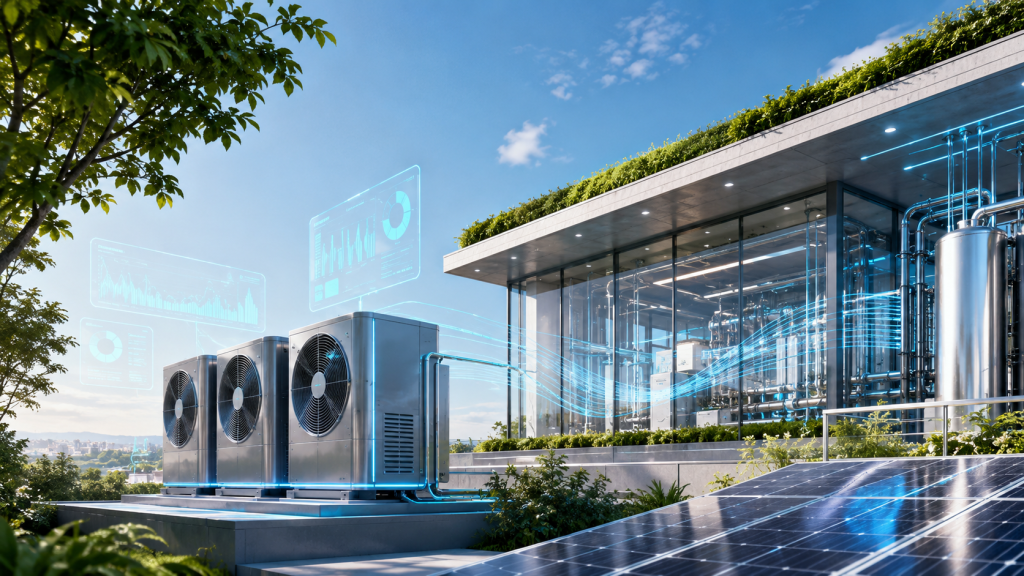
THE FUTURE OF HVAC
How Energy Efficiency, Low-GWP Refrigerants and Smart Technology Are Transforming Cooling
The heating, ventilation, air conditioning and refrigeration (HVAC/R) industry is entering one of the most important periods of change in its history. Cooling is no longer viewed simply as a way to maintain indoor comfort. It has become closely connected to energy consumption, operating costs, environmental responsibility, regulatory requirements and the long-term resilience of businesses and communities.
Across commercial buildings, industrial facilities, hospitals, hotels, supermarkets, warehouses and data centres, demand for reliable cooling continues to grow. At the same time, customers are increasingly looking for systems that consume less energy, operate more efficiently and have a lower environmental impact.
The challenge facing the industry is therefore becoming more complex. The question is no longer simply how to provide more cooling. It is how to provide better cooling with greater efficiency, reliability and environmental responsibility.
This transformation is creating a new generation of HVAC technologies and practices, from high-efficiency equipment and lower-global-warming-potential refrigerants to intelligent controls, predictive maintenance and responsible refrigerant lifecycle management.
A Growing Need for Efficient Cooling
The world’s demand for cooling continues to rise. Urbanization, economic development, higher temperatures and the expansion of commercial and industrial infrastructure are all increasing the need for air conditioning and refrigeration.
The International Energy Agency has identified space cooling as one of the fastest-growing sources of electricity demand in buildings. Global air-conditioner shipments have also continued to grow rapidly, particularly in emerging and developing markets.
This growth is essential for modern life and economic activity. Reliable cooling protects food, supports healthcare, maintains pharmaceutical products, enables industrial production and provides safe and comfortable working environments.
However, increasing cooling demand also creates pressure on electricity systems and business operating costs.
For a commercial building, for example, an HVAC system may operate for thousands of hours each year. Even a relatively small difference in energy efficiency can therefore become significant when calculated over the entire operating life of the equipment.
This is why energy efficiency is becoming more than an environmental objective. It is becoming a business performance issue.
Businesses are increasingly looking beyond the initial cost of purchasing HVAC equipment and considering what the system will cost throughout its lifetime. Electricity consumption, maintenance, repairs, refrigerant requirements, equipment reliability and eventual replacement all contribute to the true cost of cooling.
A system that is inexpensive to purchase may not necessarily be inexpensive to operate.
The future of HVAC will therefore increasingly favour systems that deliver strong performance while controlling energy consumption and long-term operating costs.
The Refrigerant Industry Is Undergoing a Major Transition
Energy efficiency is only one part of the transformation taking place in HVAC/R.
Refrigerants are also changing.
Refrigerants are essential to the operation of air-conditioning and refrigeration equipment, but different refrigerants have different environmental characteristics. The industry has already experienced major transitions away from substances associated with ozone depletion, and attention has increasingly shifted toward reducing the climate impact of refrigerants.
One of the most important international developments is the Kigali Amendment to the Montreal Protocol.
Adopted in 2016, the Kigali Amendment established an international framework for phasing down hydrofluorocarbons, commonly known as HFCs. The United Nations Environment Programme’s Ozone Secretariat describes the agreement as a major step toward reducing high-GWP HFCs, with an expected global reduction of around 80–85% by 2047 under the agreed phase-down framework.
This transition is reshaping the entire HVAC/R supply chain.
Manufacturers are developing equipment designed for alternative refrigerants. Contractors need to understand new system requirements. Technicians require updated training. Distributors need reliable access to suitable products. Facility managers must understand what refrigerants are currently used in their equipment and what future replacements may be appropriate.
For businesses operating cooling equipment today, refrigerant transition should therefore be considered a long-term planning issue rather than a short-term market trend.
Low-GWP Refrigerants and the Search for Better Solutions
The HVAC/R industry is increasingly adopting and evaluating refrigerants with lower global warming potential.
Natural refrigerants such as ammonia, carbon dioxide and hydrocarbons are receiving significant attention, while lower-GWP synthetic refrigerants are also being developed and adopted for specific applications. UNEP identifies these technologies as important elements of the global transition toward more sustainable refrigeration and air conditioning.
However, selecting a refrigerant is not simply a matter of choosing the lowest available GWP.
HVAC professionals must consider the application, system design, operating conditions, energy efficiency, safety characteristics, equipment compatibility, availability and applicable regulations.
Flammability and toxicity are particularly important considerations for certain refrigerant categories. A refrigerant that performs well in one application may not be appropriate for another.
This means the future of refrigerant selection will require a more professional and application-specific approach.
The objective should be to identify a solution that balances environmental performance, safety, energy efficiency, system reliability and commercial practicality.
This is also why technical knowledge is becoming increasingly important within the refrigerant supply chain.
Refrigerant Leakage Remains a Major Challenge
The environmental performance of an HVAC system depends not only on the refrigerant selected but also on how that refrigerant is managed.
Refrigerant leakage can occur because of poor installation, damaged components, loose connections, corrosion, mechanical vibration, ageing equipment or inadequate maintenance.
When leakage occurs, the system may lose cooling performance while requiring additional refrigerant and service intervention.
For businesses, this can create unnecessary costs. For the environment, it can increase the release of refrigerants into the atmosphere.
Leak prevention should therefore be treated as an important part of professional HVAC management.
Modern maintenance practices increasingly need to focus on identifying the cause of refrigerant loss rather than simply replacing the lost refrigerant.
A well-managed system should be inspected, maintained and monitored so that leakage can be detected early and corrected before it becomes a repeated problem.
UNEP OzonAction emphasizes good servicing practices, leak prevention, recovery, recycling and reclamation as important elements of responsible refrigeration and air-conditioning management.
Sustainability Does Not End With Installation
A sustainable HVAC strategy must consider the complete life of a cooling system.
Refrigerant management begins when the product enters the supply chain and continues through installation, charging, operation, servicing, recovery and eventual equipment retirement.
This lifecycle approach is becoming increasingly important as governments, businesses and customers pay greater attention to environmental performance.
Proper refrigerant records can help facility managers understand what equipment they have, which refrigerants are being used, how much refrigerant has been added during servicing and whether repeated leakage is occurring.
At the end of an equipment’s useful life, responsible recovery and appropriate handling of refrigerants can help prevent unnecessary environmental releases.
Sustainability therefore requires more than purchasing a lower-GWP refrigerant.
It requires responsible management from beginning to end.
Smart Technology Is Changing How HVAC Systems Operate
The next major transformation in HVAC is digitalization.
Modern HVAC systems are increasingly connected to sensors, automated controls, building management systems and data platforms.
Instead of operating equipment according to fixed settings alone, intelligent systems can respond to actual building conditions.
Temperature, humidity, occupancy and operating conditions can be monitored continuously. This allows cooling systems to respond to changes in demand rather than operating unnecessarily at full capacity.
For a commercial building, cooling requirements may change significantly throughout the day. Occupancy may be high during working hours and much lower at night. Meeting rooms may require intensive cooling for short periods, while other areas may remain largely unused.
Smart HVAC controls can help match cooling operation to these changing conditions.
This creates an opportunity to improve comfort while reducing unnecessary energy consumption.
The combination of sensors, automation, energy monitoring and data analysis is therefore turning HVAC systems into increasingly intelligent infrastructure.
Predictive Maintenance Is Becoming the Next Step
HVAC maintenance has traditionally relied heavily on scheduled servicing and reactive repairs.
A system may be inspected at regular intervals and repaired when a problem becomes obvious.
Predictive maintenance offers a different approach.
By monitoring system performance, businesses can identify signs that equipment may be developing a problem before a major failure occurs.
Changes in energy consumption, temperature performance, pressure, vibration, compressor behaviour or refrigerant levels can provide useful indications of equipment condition.
This creates a progression from reactive maintenance toward preventive and predictive maintenance.
For facilities where cooling is critical, this approach can be particularly valuable. Unexpected HVAC failure can interrupt business operations, damage temperature-sensitive products or create uncomfortable and unsafe working conditions.
The ability to identify problems earlier can help businesses improve reliability and plan maintenance more effectively.
Sustainable Cooling Begins With the Building
Although HVAC technology is important, the efficiency of a cooling system is also influenced by the building in which it operates.
A poorly insulated building with excessive solar heat gain may require substantially more mechanical cooling than a well-designed building.
This is why sustainable cooling increasingly combines efficient HVAC equipment with passive cooling strategies.
Building orientation, shading, insulation, efficient windows, reflective surfaces, natural ventilation and improved building envelopes can all influence cooling demand.
UNEP’s sustainable cooling framework emphasizes the importance of combining efficient equipment, sustainable refrigerants and passive cooling rather than treating these areas separately.
This approach changes the way businesses should think about cooling.
Instead of asking only how powerful an air-conditioning system needs to be, building owners can also consider how the building itself can reduce the amount of cooling required.
Reducing the cooling load first and then providing that cooling as efficiently as possible can create a stronger overall sustainability strategy.
The Challenge of High-Ambient Environments
Climate conditions also matter.
HVAC systems operating in hot regions can face significantly higher cooling loads and more demanding operating conditions. High outdoor temperatures can place additional stress on compressors, condensers and other components while increasing energy requirements.
This is particularly important for businesses operating across regions such as the Middle East, Africa and other hot climates.
A sustainable HVAC solution must therefore be suitable for the actual environment in which it will operate.
Environmental performance cannot be considered separately from reliability and technical suitability.
The most effective solution is one that provides the required cooling performance while maintaining safety, efficiency and reliability under local operating conditions.
The HVAC Workforce Must Evolve With the Technology
As equipment and refrigerants change, the skills required by HVAC professionals are also changing.
Technicians need to understand new refrigerant properties, safe handling requirements, recovery procedures, leak detection, charging practices and increasingly sophisticated control systems.
Digital HVAC technology also means that technicians may increasingly interact with sensors, monitoring platforms and automated systems in addition to traditional mechanical components.
Training is therefore becoming an important part of the industry’s transition.
UNEP has highlighted technician training and improved servicing practices as important components of the movement toward more sustainable refrigeration and air conditioning.
The HVAC technician of the future will need to combine traditional technical knowledge with an understanding of environmental responsibility, digital technology and changing regulatory requirements.
Sustainability Can Also Improve Business Performance
Sustainability is sometimes presented as an additional cost for businesses.
In HVAC, however, the relationship can be different.
An efficient and well-maintained system can reduce electricity consumption, minimize refrigerant losses, improve reliability and potentially extend equipment life.
Better maintenance can reduce unexpected repairs. Better controls can reduce unnecessary operation. Leak prevention can reduce refrigerant consumption. Efficient equipment can lower energy costs.
These improvements can contribute to both environmental performance and commercial performance.
For facility managers, sustainability should therefore be viewed as part of effective asset management rather than simply a corporate environmental initiative.
The opportunity is to create cooling systems that are simultaneously more efficient, more reliable and more responsible.
What This Transformation Means for HVAC Contractors
HVAC contractors are increasingly becoming advisors as well as installers.
Customers need assistance understanding which equipment, refrigerant and maintenance strategy is appropriate for their facilities.
Contractors who can provide installation, maintenance, refrigerant management, energy-efficiency advice and technical guidance can create greater value than those competing primarily on installation price.
The changing refrigerant landscape also creates an opportunity for contractors to strengthen their technical capabilities and build long-term relationships with customers.
As HVAC technology becomes more sophisticated, knowledge will become an increasingly important competitive advantage.
The Opportunity for Frostchem Global
These changes create an important opportunity for Frostchem Global.
The company operates within an industry where customers increasingly require more than a product. They need reliability, technical information, responsible refrigerant solutions and confidence that their supplier understands where the market is going.
Frostchem can strengthen its position by presenting itself as a knowledgeable and dependable HVAC/R partner.
Reliable refrigerant supply remains fundamental. Contractors, distributors and industrial customers need products to be available when they are required.
However, supply alone is not enough to create long-term differentiation.
Customers also value product knowledge, technical guidance, information about refrigerant transitions and an understanding of responsible refrigerant management.
This gives Frostchem an opportunity to build industry authority through education and professional communication.
By publishing useful information about refrigerants, energy efficiency, sustainable cooling, maintenance and emerging HVAC technologies, Frostchem can engage customers not simply at the point of purchase but throughout the decision-making process.
The company’s role can therefore evolve from supplier to trusted industry partner.
Looking Ahead
The future of HVAC will not be defined by one technology or one refrigerant.
It will be shaped by the integration of several developments: energy-efficient equipment, appropriate low-GWP refrigerants, smart controls, better maintenance, leak prevention, skilled technicians, improved buildings and responsible lifecycle management.
The industry is moving from a traditional model in which cooling equipment is installed and serviced when something goes wrong toward a more connected model in which systems are monitored, optimized and managed throughout their operating lives.
For businesses, this transformation presents an opportunity to reduce operating costs while improving environmental performance.
For HVAC professionals, it creates a need for continuous technical development.
For refrigerant suppliers, it creates an opportunity to provide greater value through knowledge, reliability and responsible solutions.
For Frostchem Global, the direction is clear.
The future is not simply about supplying refrigerants. It is about understanding the changing needs of the HVAC/R industry and helping customers navigate the transition toward more efficient, reliable and sustainable cooling.