
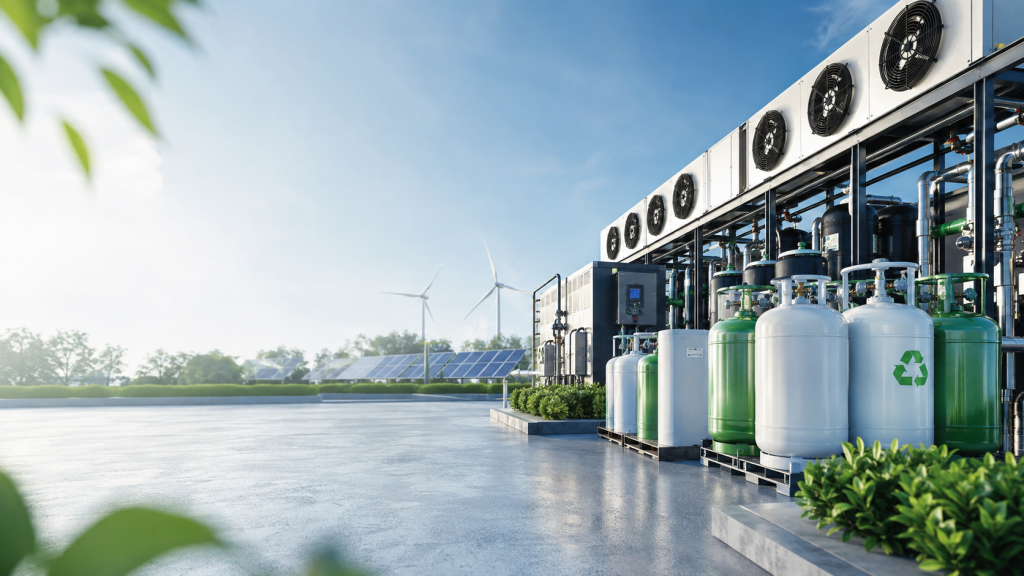
Sustainability has become one of the most overused words in business. By now, it has been attached to so many marketing campaigns, annual reports, and corporate pledges that it has almost lost its meaning. And in the refrigerant and industrial chemicals industry — our industry — the gap between what companies say about sustainability and what they actually do has historically been wide.
We want to be different. Not because it makes us look good, but because we genuinely believe that the environmental commitments our industry makes today will determine whether it has a future worth being part of. This blog is our attempt to talk about sustainability honestly — what it actually means in the refrigerant business, where the real impact lies, and what we are doing about it at FrostChem Global FZE.
The Environmental Reality of What We Do
Let us start with the facts, because they matter and they should not be softened. Refrigerants are among the most environmentally potent substances in commercial use. R-410A, the standard refrigerant for residential air conditioning for the past two decades, has a Global Warming Potential of 2,088. That means that one kilogram of R-410A released into the atmosphere has the same warming effect as 2,088 kilograms of CO2. R-404A, widely used in commercial refrigeration, has a GWP of 3,922.
These numbers represent the real-world environmental cost of refrigerant leakage, improper disposal, and inadequate recovery practices across millions of systems worldwide. When we talk about the transition to R-32 (GWP: 675), R-454B (GWP: 466), and HFOs (GWP below 10), we are not talking about a regulatory compliance exercise. We are talking about a genuine, measurable reduction in the contribution our industry makes to climate change. That is worth taking seriously.
The Practice That Matters Most — and Gets the Least Attention
If you want to know what the single highest-impact sustainability practice in the HVAC and refrigeration industry is, it is not switching to the latest low-GWP refrigerant. It is proper refrigerant recovery.
Every time a system is serviced or decommissioned and the refrigerant is vented into the atmosphere rather than recovered, that is a direct and entirely preventable greenhouse gas emission. Every kilogram recovered, reclaimed, and returned to service is a kilogram that did not contribute to atmospheric warming. It is also a kilogram that does not need to be manufactured — which has its own energy and environmental cost.
Refrigerant recovery is not a regulatory nuisance. It is the most direct environmental action our industry can take — and it can be made simple with the right support.
FrostChem Global FZE’s refrigerant recovery and analysis services exist to make this practice as simple as possible for contractors and facility managers across the MENA region. We collect, analyze, and where appropriate reclaim refrigerants — putting them back into service rather than into the atmosphere. This is practical sustainability. It is measurable. It is real.
Why Green Procurement Is Now a Commercial Issue
Something has shifted in the procurement landscape across the UAE and GCC, and if you have not noticed it yet, you will soon. The UAE’s Net Zero 2050 Strategic Initiative, Saudi Vision 2030, and the broader ESG commitments of major corporations operating in the region are translating into procurement policies that favor suppliers who can demonstrate environmental compliance.
This means that if your business supplies refrigerant gases or industrial chemicals to large contractors, government projects, or corporate facility managers, your ability to show that your products are certified, low-GWP where appropriate, and supplied through environmentally responsible processes is becoming a commercial qualification — not a nice-to-have. The businesses that understand this now are building a moat that will be very hard for late movers to cross.
Our portfolio of eco-friendly refrigerants and environmentally compliant industrial chemicals was built with this reality in mind. Not as a marketing position. As a strategic choice about which market we want to serve — and that market is growing faster than any other segment in our industry.
What the Cylinder Buy-Back Program Is Really About
We want to tell you what our cylinder buy-back program means to us, because we think it illustrates something important about how we think about sustainability.
When a used cylinder comes back to us, we inspect it, recertify it where appropriate, and return it to service. This means fewer cylinders in waste streams, fewer raw materials consumed in manufacturing new ones, and a financial return to the contractor or operator who handed it back. This is not complicated. It is circular economy thinking applied to one specific, practical problem in our industry. And it is the kind of thinking that can be replicated across dozens of other decisions if businesses are genuinely committed to doing things differently.
We are not perfect. No business in our industry is. But we are genuinely committed to making sustainability something that is visible in our day-to-day operations, not just in our communications. That is the kind of supplier we want to be — and the kind of industry we want to help build across this region.